
Playdate Season 3 review - Part 1
Well, here we are…it’s Playdate Season 3! A curated bundle of eight new games, delivered two per week, starting October 8, 2026. Honestly, I didn’t think this would happen, but I’m very glad it did. Panic’s little yellow handheld is a fantastic gaming device, and it’s cool to see the platform grow.
As we all know, the Playdate launched with an innovative concept for its game distribution, a “season” of games released incrementally, timed out over multiple weeks. The global pandemic kind of ruined their experiment however, as supply chain issues and production delays meant that no one ended up starting their seasons at the same time. The shared experience of everyone playing the same two games simultaneously, and discussing them online, wasn’t really possible. But Panic didn’t give up on the season idea, releasing a Playdate Season 2 in May 2025.
While Playdate Season One contained 24 games, Season 2 was a bundle of 12 games (13 if you count Blippo+). Season 3 is even lighter, containing only eight titles. It makes sense that Season One would need to have a sizeable collection of games, as the value proposition of the device really hinged on those titles, especially early on. Heck, before Catalog was rolled out in March 2023, the first season was basically the entire library of official Playdate games. That said, it is somewhat interesting that Season 3 has fewer games than Season 2. It makes me wonder if a Season 4—which now I feel is more likely than not—might have even less games still? Only time will tell.
One interesting tidbit I noticed about this season is that it has a disclaimer about AI usage: “All games in Season Three were created without the use of generative AI.” While I didn’t mention it in my Playdate Season 2 review, there was one game (Wheelsprung) that had been developed using AI. When this detail came out, it was genuinely upsetting to a good portion of the Playdate community (myself included) and I imagine Panic must have learned a lesson there. So no worries this time, friends; Season 3 is completely AI-free! Just as God intended.
Alright, that’s enough preamble, let’s get to the games. Just like last time, we will review all the games in Playdate Season 3, splitting the coverage into two posts. We’ll look at the first half of the season here and then cover the back half next time. Personally, I’m really excited for the games they’ve teased so far. So let’s see how they feel in the hand, shall we?
Week 1
The premier title of Season 3 is Soggy Froggy. This is the latest game from team root, the folks who previously created Root Bear. Much like with Root Bear, this game has simple crank-based mechanics, a clearly defined premise, and features cute animals interacting with liquid, I guess. It’s just that this time it’s frogs instead of bears…and bath water instead of root beer.
Honestly, I think the frog theme of this game is more appealing to me personally, but I am, of course, a big fan of amphibians (and reptiles). After all, it was the game Pull Frog that really got me started on reviewing Playdate games in the first place.
The premise of Soggy Froggy is straightforward. This frog is feeling a bit dried out, and wants a spa day, choosing to soak in a nice warm bath. The bath tub appears to be a witch’s cauldron though, a setup that tends to get extremely hot quite rather quickly. Luckily, stirring the cauldron reduces the water temperature just as quickly, with seemingly magical expeditiousness. So an unstirred pot will rapidly boil, but an overstirred pot will swiftly freeze. And thus the player’s task is to stir the pot—using the Playdate’s crank— to keep the water temperature somewhere inside the froggy-safe range.
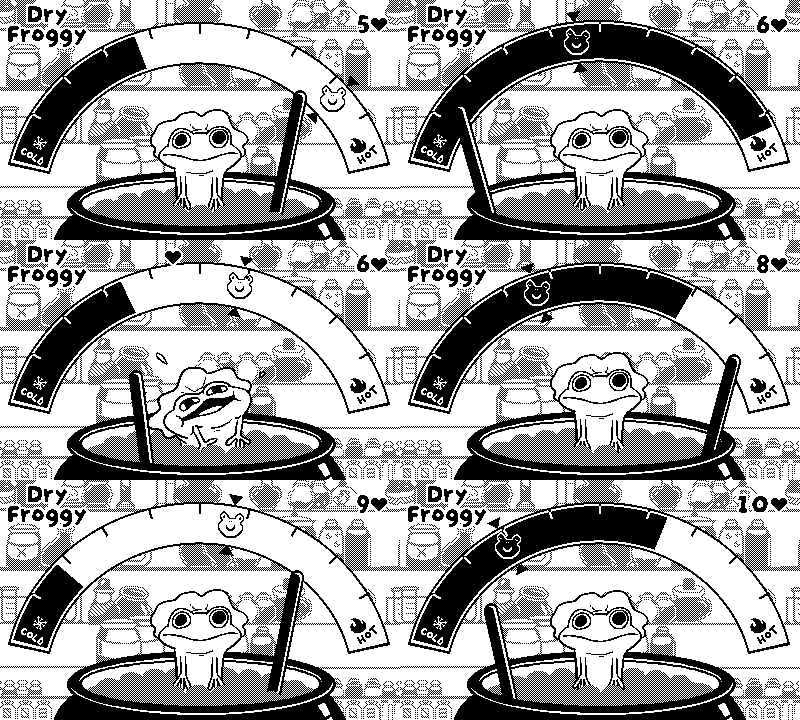
The current water temperature is prominently displayed and a big arcing thermometer at the top of the screen. Along the way, little “sweet spot” icons will appear somewhere on the thermometer. You need to hit these temps in order to keep the frog happy, and each one adds a point to your score. Every once in a while a “super sweet spot” will appear, which gives you the opportunity to score extra points by keeping the temperature in a specific zone for a few seconds. The goal is to rack up as many points as possible before you go bust, and that’s about all there is to it.
It must be said that Soggy Froggy is incredibly charming. The cartoonish visual style is bouncy and lively, but also clear and constituent. The frogs are adorable and, at times, genuinely funny. The sound design is also really good, leaning pretty hard into ribbits and croaks. There are some subtle danger noises—a steaming kettle sound on the hot side and the shivery sound of chattering teeth on the cold end—increasing in volume the closer you come to crashing out. The best audio in game, however, is the ambient nature sounds that play on the Main Menu, and even more clearly on the Game Over screen. It almost sounds like someone set up a microphone next to a pond at night and recorded frogs in their natural habitat. The result is really peaceful and lovely.
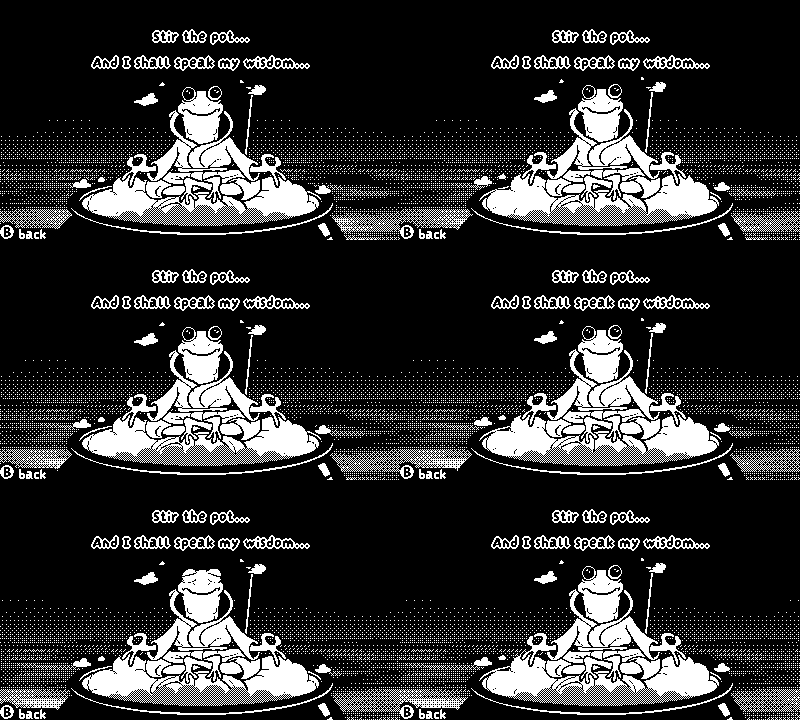
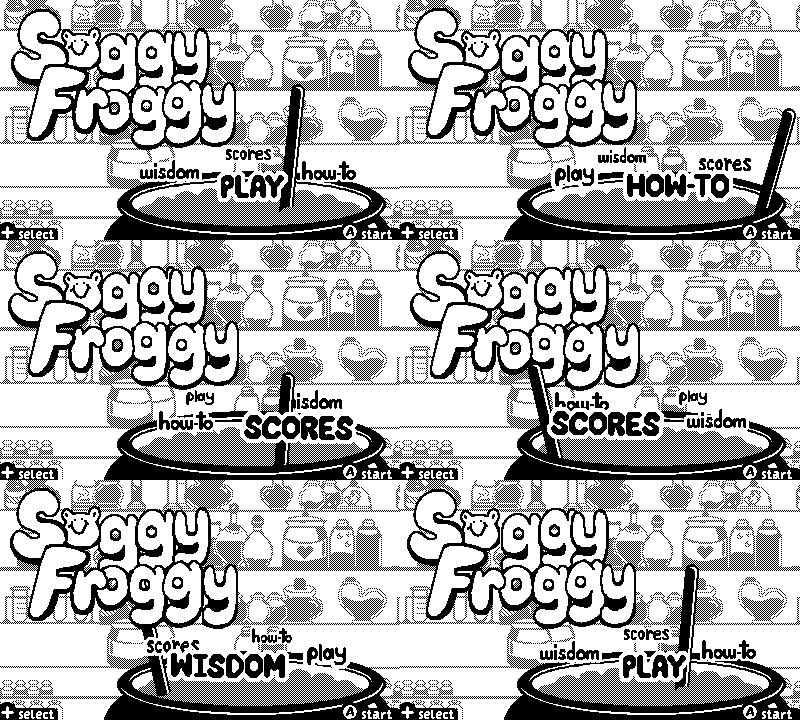
In addition to the standard game, Soggy Froggy also offers a “Wisdom” mode. Here an enlightened-looking frog in a robe gives you pithy nuggets of prophecy, zen koan-esque riddles, or positive affirmations. The player must stir the pot to a sufficient degree and then the froggy monk will deliver some fresh hit of fortune cookie foresight. This Wisdom addition, while completely necessary, is fun diversion and a nice touch. It’s kind of like tacking a Magic 8-ball onto the game, but within the froggy spa day theme, it somehow feels completely appropriate.
In terms of gameplay, Soggy Froggy is a little too simplistic for my tastes. While it’s certainly a charming package, I kind of wish there was a bit more video game to engage with here. Also, for being as basic as it is, the gameplay actually felt a lot more difficult than I was expecting. Perhaps this one’s a real “easy to learn, difficult to master” type of game, although I’m not sure I would give it that much credit. Frankly, I just don’t find keeping a gauge within a specific range to be all that compelling, even if the Playdate’s crank is the input device you're using to do this. It is funny, sure, but I just wish there was a bit more meat on these amphibious bones.

As previously mentioned, I do find Soggy Froggy to be incredibly charming. The froggy theme, the quality cartoonish art and clean presentation, the surprisingly great sound design; it’s all very impressive. Even the unnecessary Wisdom mode is a nice touch. However, as a game, it’s not necessarily my favorite. This one is cute and I am a sucker for frogs, but the “stir the pot” gameplay is a little too basic to hold my attention.
Next up we have Gloom Gate, created by LuBu (Lukas Büffel). And WOW, the look of this one grabbed my attention right from the jump! This game is a “reaction-based action RPG”, so basically a soulslike on Playdate. You play as a solitary knight making their way through an ominous castle to find the titular “Gloom Gate”, so the game is also a dungeon crawler.
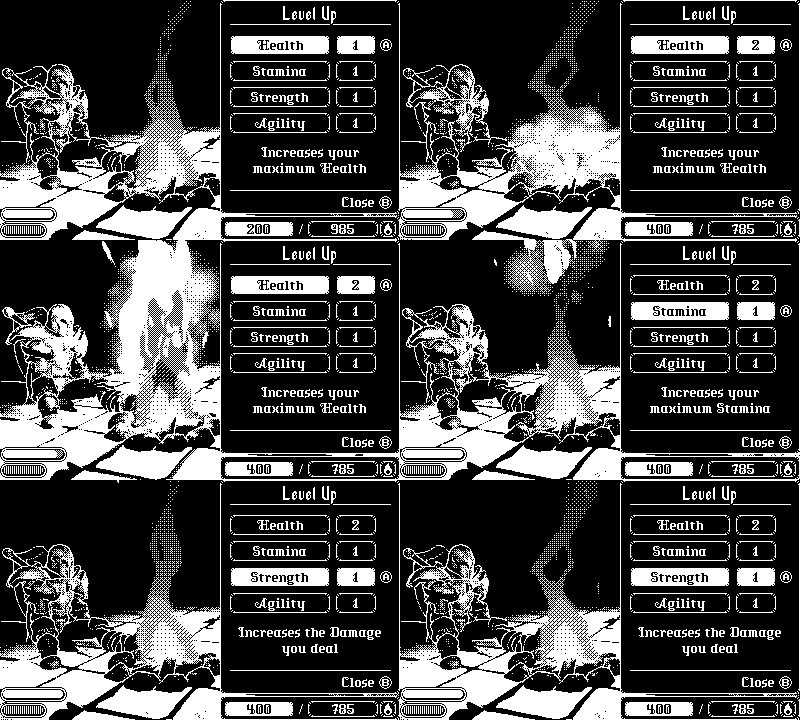
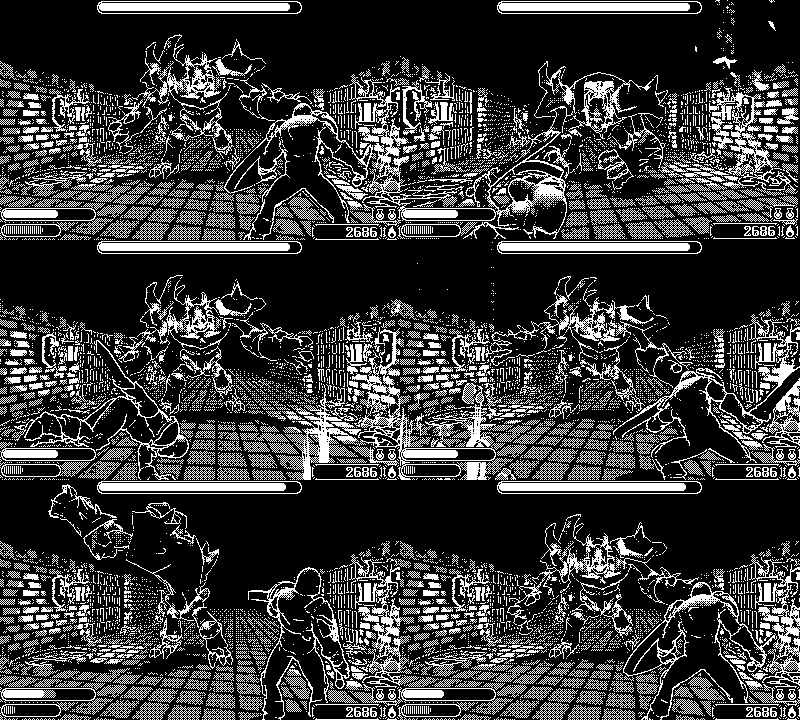
Combat is real-time, with a 3rd-person over-the-shoulder view. Navigation through the maze-like castle is done with nodes connected along a map. In combat, the player can attack with your sword (A Button), parry incoming attacks with your shield (B Button), and dodgeroll to the left or right (Left/Right on the D-pad).
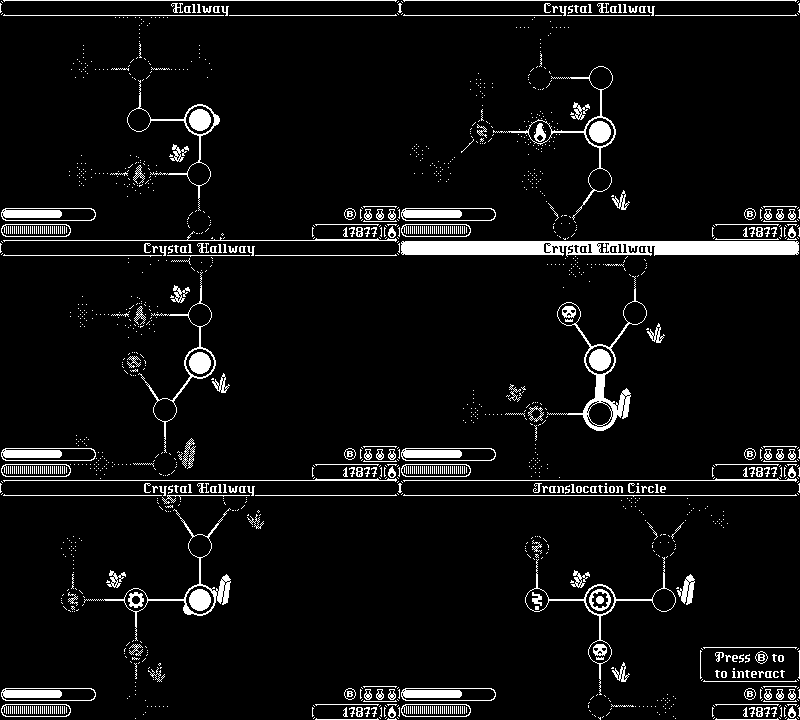
You can also block by holding Down on the D-pad…and even perform a charge attack by holding Down and pressing the A Button. However, I didn’t actually learn you could block until my character was like Level 7. Also, parrying just seems to be a lot more useful than blocking, so I rarely find myself doing that.
In battles, you have both a Health Bar and a Stamina Gauge, and any actions you perform deplete your stamina. The game already demands fairly tight timing to successfully parry enemy attacks, so having to manage your stamina adds another layer of challenge. Simply dodging to the side and then throwing out attacks with reckless abandon will not get you very far. I quickly learned that being patient and attacking only at choice opportunities is a much better strategy.
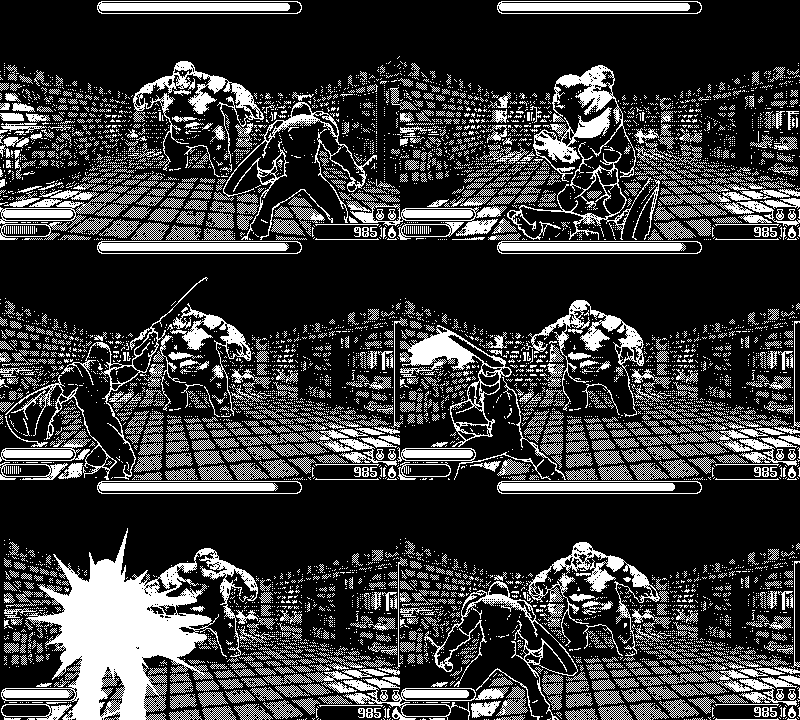
While Dark Souls would appear to be a clear inspiration, I have to wonder if UFO 50’s Valbrace might have also influenced this game. The over-the-shoulder perspective, the side-to-side moment, plus the sword and shield wielding protagonist traversing a gothic dungeon; it all reminded me of Valbrace.
At first glance, this one appears to be a 3D action game running on the underpowered Playdate. However, since that hardly seems possible, I imagine the developer is making clever use of 3D-modeled characters and environments, but rendered in the game as flat 2D sprites. (That’s the same technique Rare used to blow people’s minds with the Donkey Kong Country series way back on the Super Nintendo.) In any case, the visuals do look absolutely amazing, with even the animations maintaining a silky smooth framerate.
There are even a few animated sequences, with a first-person perspective moving through the environment, that manage to look like true 3D. Again, these must be prerendered videos, but the black and white gothic aesthetic is so consistent that my eyes couldn’t tell the difference. It’s pretty crazy that it looks so freaking good, as you’d never guess that the Playdate could handle an action game like this.
In fact, the first time I sat down to play Gloom Gate, it seemed like maybe the handheld couldn’t handle this game after all, because my Playdate’s screen froze in the middle of a fight. I had to do a manual reset by sticking a pin into the tiny hole hidden in the device’s crank dock. Then this happened again a second time—with the screen freezing right in the middle of combat—a few days later. Then it happened for a third time, and then a fourth! Having your Playdate freeze up on you like this is extremely frustrating, so by the fourth occurrence I felt that I needed to put this game down and simply stop playing.
Now, I’m not really sure if I should blame the game for the frozen screen glitch, or the handheld itself. This kind of thing has been happening to my Playdate intermittently for at least the last year, and I suspect there could be a short in between the screen and the motherboard. Still, Gloom Gate’s action-oriented gameplay of real-time battles doesn't seem to help my screen problems one bit.
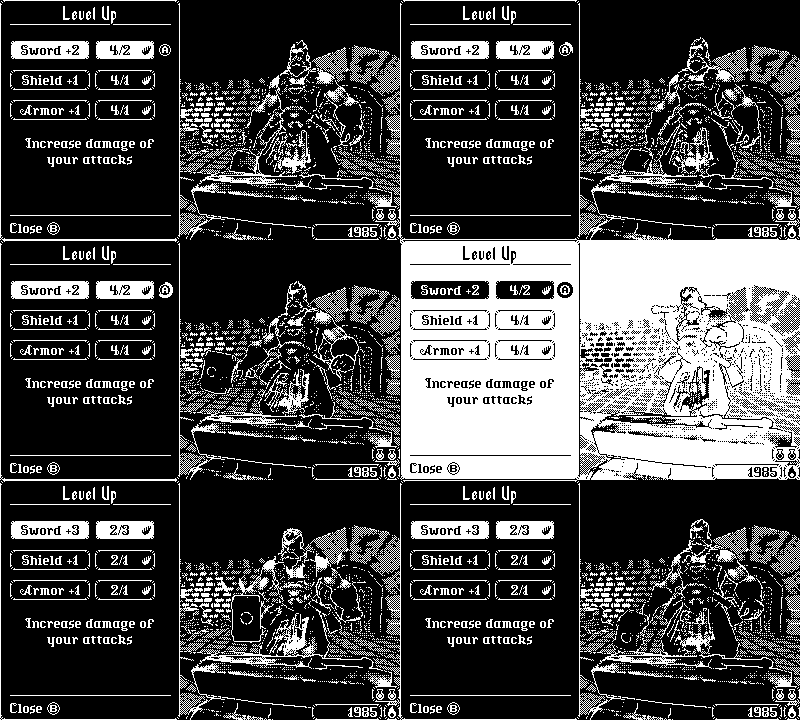
Gloom Gate is so wildly ambitious, and yet is executed so well, that it has to be one the most single impressive Playdate games to date. The real-time battle system is challenging and genuinely fun. Translating soullike combat to the Playdate, with its limited input options, is already a huge achievement. But then including a massive map to explore, equipment to collect and upgrade, and player attributes to level-up; this game is truly an 8-bit powerhouse.
Even the aesthetics of the game, which I was anticipating to be overly dark and dour for my tastes, are nearly perfect. Obviously the game is quite gloomy, but the gothic horror is more entertaining than it is depressing. Monster designs are particularly appealing, with some cool skeletal phantoms and lumbering beasts to fight. The fact that your basic rat enemy appears to be approximately the size of a bear is a nice touch. And there are big ol’ mushroom monsters who look like Toad from Super Mario Bros. crossed with the Incredible Hulk, which is a combo I never knew I needed in my life.
Unfortunately the audio side doesn’t impress as much as the visuals do. Granted the sound effects are excellent, and they can actually help in combat gameplay by providing handy audio cues. The music, however, is quite stark. As far as I could tell, there’s only one background music track, and it just plays all the time, whether you are traversing the map or in combat. There’s nothing wrong with this tune per se, as it certainly gets the job done. But hearing the same music loop the entire time can become monotonous.
All things considered, Gloom Gate is a critical hit. This game appears to be the technical showcase title Playdate Season 3, a real showstopper that is sure to get everyone’s attention. We will hold off on ranking the Season 3 games until we’ve gotten a chance to play all them, of course. But I have a feeling that Gloom Gate will be near the very top. LuBu’s 8-bit soulslike dungeon crawlers is a true standout.
Week 2

To kick off Week 2 we have Bonkhope made by indiana-jonas. If that developer name sounds familiar, perhaps it’s because he made the excellent Long Puppy game in Playdate Season 2. Since his last title was highlight of Season 2, it makes sense they’d invite him back for Season 3.
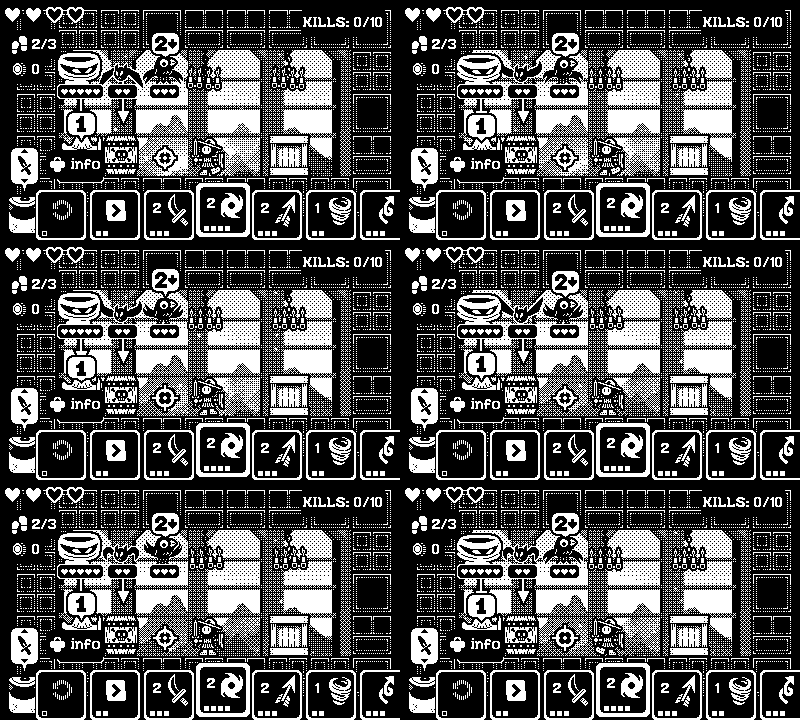
Bonkhope is described as a “turn-based roguelike” and appears to be categorized as a Strategy RPG. Personally I would describe it as a turned-base strategy puzzle game. You have a limited number of actions you can perform each turn, and you’re trying to strategically plan each step in order to eliminate all enemy creatures on the playfield, which is laid out on a 2D grid.
This game reminds me an awful lot of another UFO 50 game, this time Bug Hunter. The style of turn-based combat—with very limited action and movement options—feels very similar to Bug Hunter, but also the way that more creatures will appear if you fail to clear the board fast enough. And while I certainly respect this kind of game design, I am really, really bad at it. Honestly, I don’t know what it is about me, but I have always been truly terrible at strategy games.
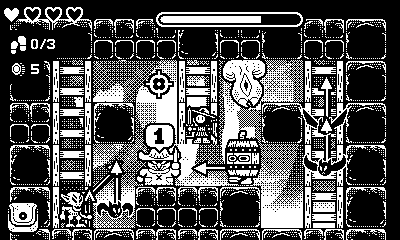
Much like with Long Puppy last season, this is a visually distinct, good-looking game, with some genuinely cute character and creature designs. The pixel art is good all-around and the cartoony art style is quite appealing. But man, I just wish I liked this game more…
Unfortunately this just isn’t a game style that I enjoy playing. I’m sure there are lots of folks who will eat this up, but this gameplay simply isn’t for me. If you like cute sprites and turn-based strategy, then make sure to give Bonkhope a try.

Our final entry for Part 1 is houm made by BuuuuBunnyGames. And holy cannoli, this game knocked my socks off!
Once again, we have intrepid video game developers creating an old school point-and-click adventure game for the Playdate, with its comically small monochrome screen. That’s quite the tall order, and yet we’ve seen it attempted before, like with The Whiteout and Shadowgate PD in the last season. Just to reiterate, the Playdate’s screen resolution is 400 × 240. And it's only a 1-bit display; meaning pixels are either black or white, with no shades of gray. Why so many people would opt to make this type of game on a platform with such tiny screen real estate is beyond me. But in this case, I’m actually glad they did.
If you’ve read our Season 2 reviews, you’ve probably heard me say how point-and-click adventure games aren’t really my thing. I didn’t grow up playing them, and often I have a hard time engaging with their style of gameplay. And yet houm really landed with me. This is an old school adventure that I definitely do enjoy.
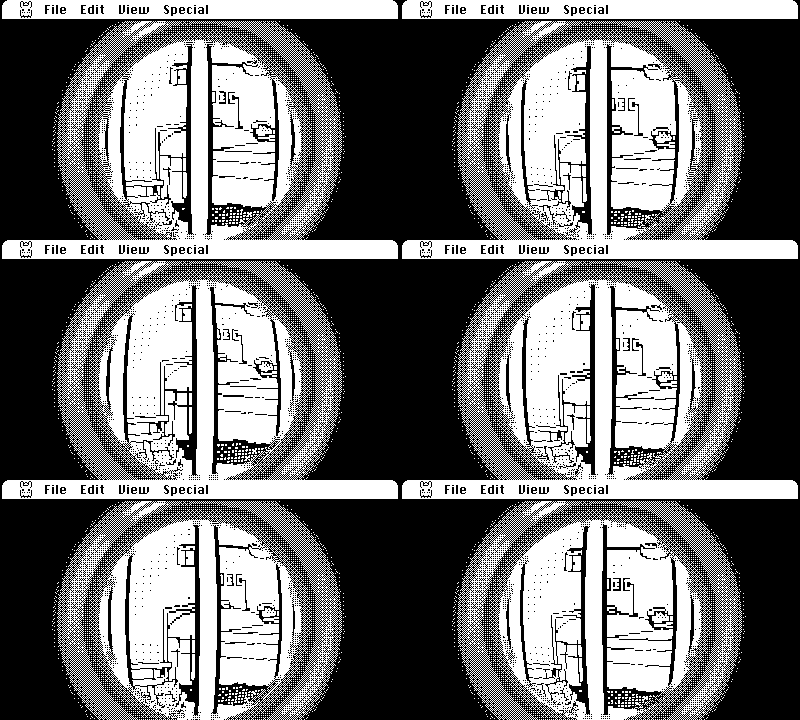
The premise of houm is that you are sneaking into an abandoned mansion in search of a hidden fortune. This creepy old house is full of puzzles that the owner—who’s gone missing, apparently—is hoping will hinder the progress of any would-be treasure hunters enough for them to abandon their search. It’s a straightforward setup and the game jumps right in. The titlescreen is literally a view of the mansion’s front exterior, as seen from inside your car. The first thing you do upon starting a new game is locate a key in order to open the front door.
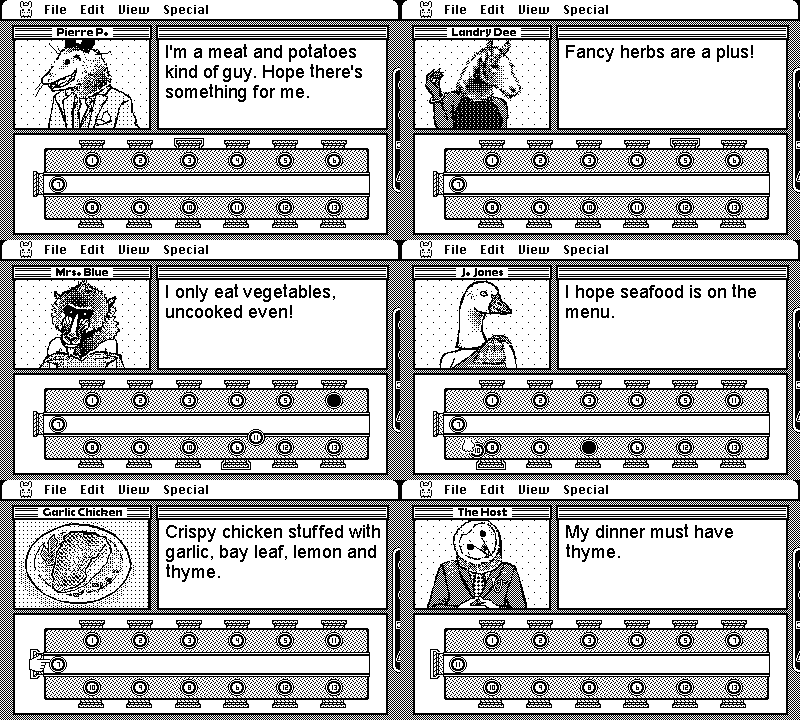
In a weird but extremely cool stylistic choice, developer BuuuuBunnyGames decided to make the game’s UI resemble an old Macintosh computer. There is a toolbar visible at the top of screen at all times—complete with the options File, Edit, View, and Special—as if the whole game was a program running in a Mac window. It’s totally unnecessary and incidentally means that they had even less screen space to use for their game. But it’s an incredibly cool homage to the MacVenture games of yesteryear.
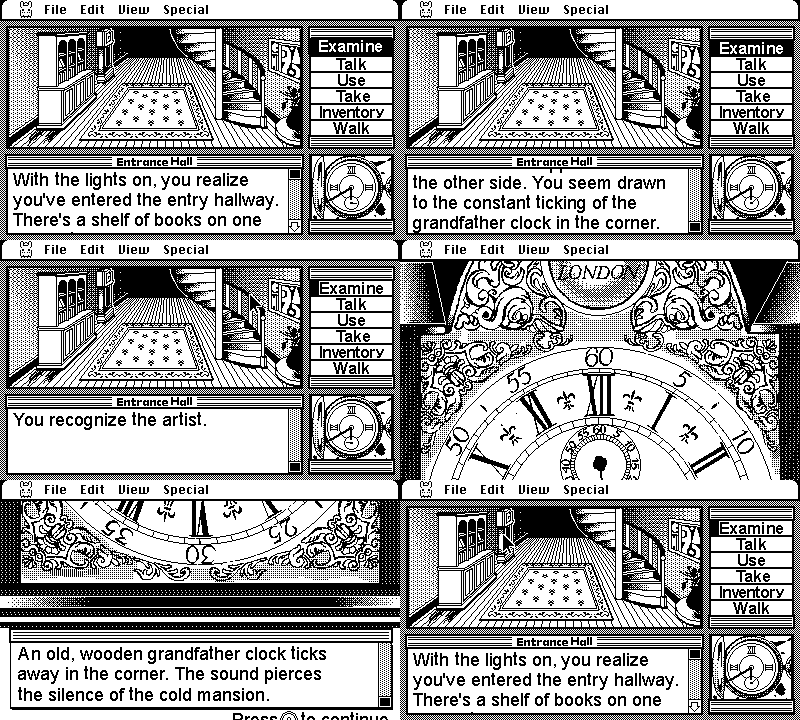
For most of the game, the screen is divided into multiple windows. The View Window takes up the most space, prominent in the upper left corner. Just below it there’s a textbox providing contextual information. On the right side you have a vertical menu of actions—Examine, Use, Walk, etc.—and you use these to interact with the environment displayed in the View Window. Finally, in the lower right corner there’s a square window that either displays the time (via an analogue clock face) or a simplified map of the current area—specifically when the player uses the Walk option to move to another location. It’s all pretty intuitive and just insanely efficient in terms of utilizing the extremely limited screen space.
While I’m praising this game’s UI and menu design here, that isn’t really why I think the game is so good. The thing that sets houm apart is its atmosphere! From the opening view of the house in the rain, this game gives off creepy mystery vibes, vaguely reminiscent of the movie Clue (1985). There is a palpable sense of foreboding as you break into this creepy old mansion and look around.
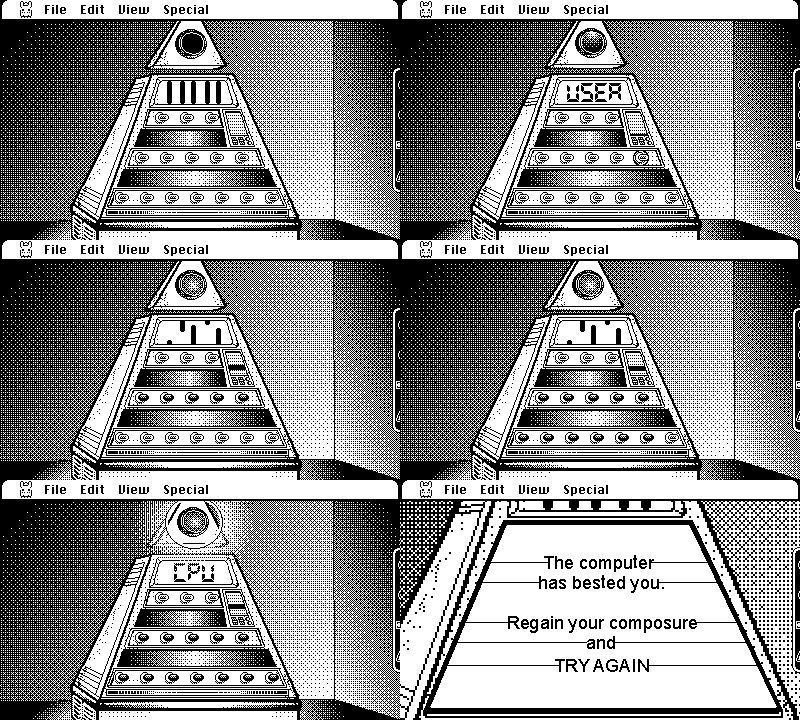
The ticking of the grandfather clock is quite ominous as the one constant sound in the background. And then when it chimes on the hour, it feels like a warning. And speaking of the clock, this game seems to have its own passage of time mechanic, kind of like Majora's Mask or Shenmue. Although I don’t think there’s a limit on how long you can take to complete the story, like those games technically have.
Overall, the puzzles I encountered in houm were quite good, and it feels genuinely amazing to figure out each secret. Admittedly, I got stuck on the Feast puzzle for so long that I eventually looked up a guide on GameFAQs for the answer. (I also had to reference the guide for what to do with the unsharpened pencil item.) There is a hint system…of sorts…in the game that unlocks midway through the adventure, but the player is strongly discouraged from using it. I also didn’t think it was very helpful, so you could just ignore it altogether.
Speaking of that hint system—but hopefully without revealing too much—at some point this game takes a sudden swerve from Clue-equse mansion mystery suspense into the realm of body horror. It was a twist that I absolutely did not see coming, and was also pretty intense. But that just added fuel to the fire of this game’s tense and ominous atmosphere.
For the third time in this post, I need to make a comparison to a UFO 50 game, this time referencing Night Manor. Night Manor and houm are both point-and-click adventure games about uncovering a mystery in a creepy house. Both are extremely atmospheric, with stories set in the 1980's (I think), and both games feature elements of body horror. And as it happens, both games became surprise favorites within their respective collections for me personally…despite my usual disinterest in the genre. I guess if you have a suspenseful tour of a creepy mansion, with a dash of horror thrown in, then the point-and-click style works fine for me.
There are a lot of clever touches the devs put into this adventure, but I especially love the fan gag. There is an electric fan running in the Game Room and your cursor can’t reach part of the screen because the fan is so strong, it just blows your cursor away. Very funny! After completing the game, it seems to have take me a little more than 2 hours and I was given a ‘C’ grade. Well, okay then.
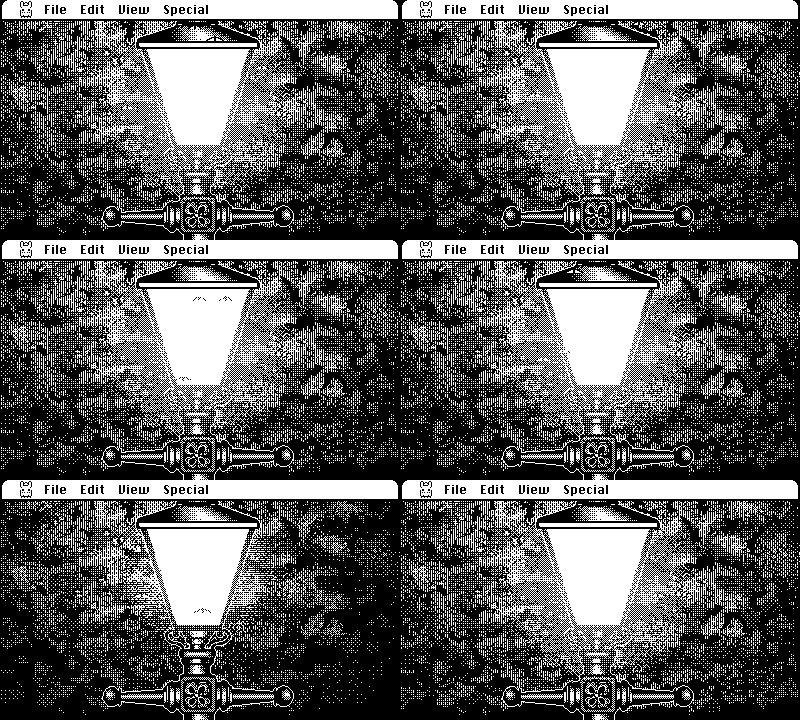
On a less positive note, this game fully crashed on me twice, each time requiring a restart of the Playdate. And unlike the screen freezing issue I encountered with Gloom Gate, this was definitely a runtime error with the game itself. That said, I was able to jump right back into the game after restarting, and I never lost any saved progress, so it wasn’t really a big deal.
Well, I’m surprised to be saying this, but houm might be my favorite Season 3 game so far. The atmosphere is truly excellent, the puzzles are well designed, and the UI is somehow both impossibly efficient and utterly charming. Speaking as someone who doesn’t usually enjoy point-and-click adventures, this one’s made a believer out of me.
And that’s all for Part 1 of our Playdate Season 3 review. Join us next time for more handheld gaming fun in Playdate Season 3 review - Part 2.