
Playdate Season 3 review - Part 2
Welcome back to our coverage of Playdate Season 3! In Part 1 of our review we discussed Soggy Froggy, Gloom Gate, Bonkhope, and houm. Now for Part 2, we’re starting right from where we left off, with the two games introduced in Week 3. Let’s go!
Week 3

Ok, now things are getting really interesting… Sound Mind, made by Chuck Jordan, is described as a “hide-and-seek game for two players sharing one Playdate”. It was specifically designed as a two-player competitive game, but one using a single handheld passed back and forth between players each turn.
The pass-and-play style of gameplay works (in theory) because of the game’s wildy elaborate sound design. See the player who’s not currently taking a turn on the Playdate is meant to be listening for audio cues to figure out what their opponent is up to. If you’re familiar enough with the game and know what to listen for, the sound effects might clue you into how best the other player. It’s a clever and genuinely ambitious concept for a Playdate game.
For its aesthetics, Sound Mind uses the old mansion murder mystery theme, which is very fun and charming. The last game we played for Season 3, houm, had a similar visual aesthetic to its environment, but this game more fully commits to the bit. Sound Mind feels far more Clue-like than houm did, and part of that is the lighthearted comedy vibe this game is going for. So if you’re a fan of the movie Clue (1985), chances are good that you will appreciate this game’s theme.
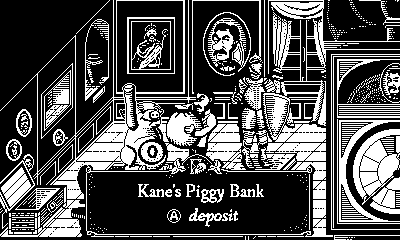
And speaking of that old-timey mansion murder mystery theme, I think Sound Mind’s cartoony art style is excellent. The spritework looks really great, not only for playable characters, siblings Kane and Mabel, but also for the interactable objects and the mansion interior itself. Despite the many wacky interactions you can trigger over the course of the game, everything is consistently rendered in the same pixel art style. Chuck Jordan did all the art himself, along with also handling the design and programming, and it’s pretty impressive work, if you ask me.
Apparently Jordan did get help with the audio side of the game, which is credited to Julian Kwasneski and Jared Emerson-Johnson of Bay Area Sound. The audio, of course, is a key component of the gameplay, since you are meant to listen to what your opponent is doing while they take their turn. Oh right, I should probably give some sort of explanation of how the game actually works…
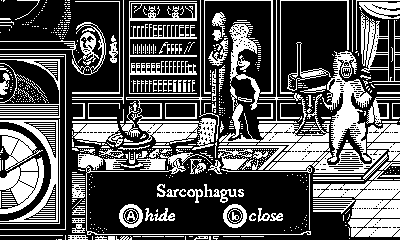
The premise of Sound Mind is that a wealthy businessman has died and his two children now have to compete with each other in order to inherit his vast fortune. These children are our two playable characters, siblings Kane and Mabel, and our dead patriarch is named “Richman Q DeSeese”, just to give you an idea of this game’s sense of humor. The gameplay environment is a large room in the interior of an old mansion, presented with 2D sprites from a top-down perspective. You guide one of the siblings around the room, searching for treasure—in this case, it’s in the form of heavy gold doubloons—and stashing the goods away to add to your score, while your opponent does the same on their turns.
Each turn lasts 90 seconds by default; although it’s variable so you can select a different time limit at the start of the game. The layout of the room is randomized at the start as well, so where the various items are placed throughout the room will be different each game. The big concept behind this game is that while one player is taking their turn, their opponent can listen in and—based on audio cues—get an idea of what they are doing. Even just moving your character around the screen generates sound, as their footsteps are audible on the hardwood floor. Holding the B Button while moving will make your character walk silently, but doing this means you move more slowly as a result.
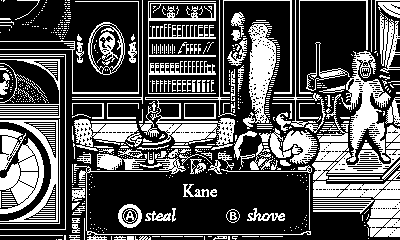
What makes things interesting is that the majority of objects in the room are interactable in some way or another. There are objects that can make noise, like a Victrola, Radio, mechanical Monkey Toy, and even a Raven just hanging out. There are big Streamer Trunks, Urns, and Footlockers that you’re able to open and close, where items can be discovered or stashed away. There are hiding places like a Sarcophagus, or a secret alcove behind Grandma’s Portrait, where you can duck out of view for your opponent’s turn.
But wait, there’s more! There are secret passageways, like one hidden behind the Bookcase, and also Magic Wardrobes that will teleport you to the other side of the room. There’s a Bottle of Sherry you can spill onto the floor, creating a puddle that can be walked through and leaving a trail of footprints for a ways afterward. And, even more provocatively, there are items you can intentionally sabotage to act as a trap to derail your opponent’s progress. There’s a medieval Suit of Armor, a taxidermied Bear, and even a creepy Boll that can each be set up as a boobytrap for your unsuspecting sibling. (If an object is sabotaged, you can avoid triggering the trap by holding the B Button to move slowly/carefully past it.)
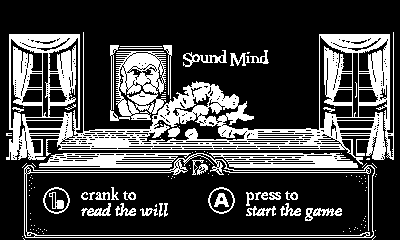
Admittedly, I have not been able to play much of this game in the way it’s intended to be played, so I can’t really say how much fun it ultimately provides. The fact that it requires two players means you need to have a friend willing to engage in the game with you, which—due to the niche nature of the Playdate itself—can be somewhat hard to come by. I was just about to recruit my wife to play a few rounds of this game with me, and she seemed willing to give it a shot. However, the Playdate crashed on me while I was playing the game solo for the first time and I kinda lost my nerve. That said, I’m sure we will get around to playing this for real eventually.
But yeah, Sound Mind is a remarkably clever and ambitious concept, brilliantly executed within the limitations of the Playdate, and just utterly charming in its aesthetic and sense of humor. It looks great, sounds amazing, and—assuming you have a friend to face off against—is one of the best multiplayer options to be found on the handheld. It’s another easy recommendation from me.
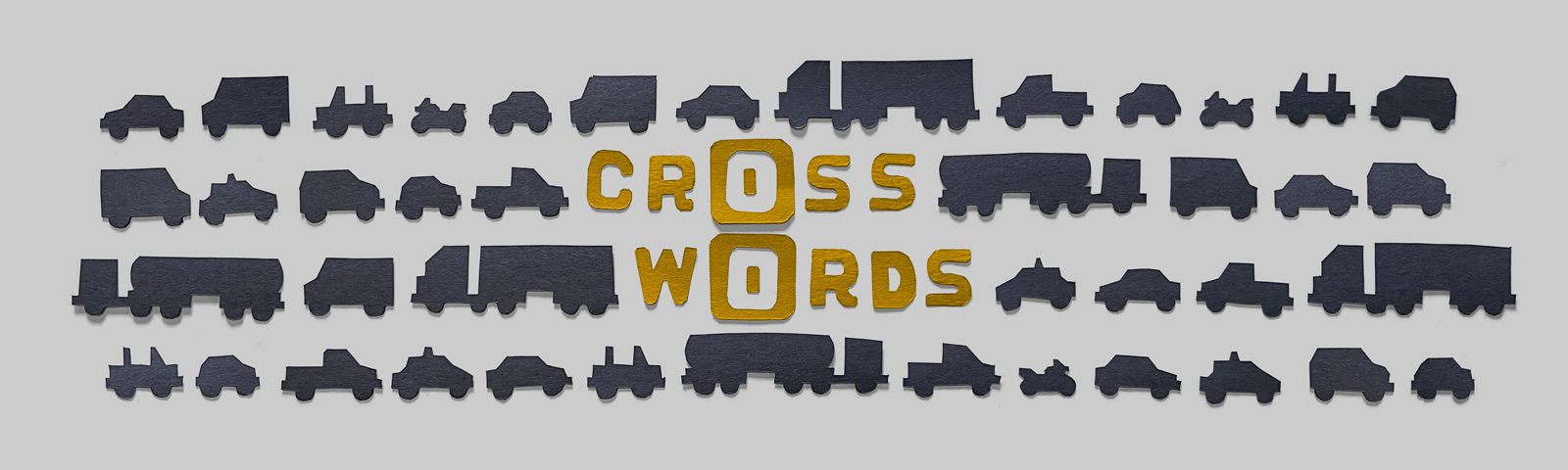
Well, this is unexpected…it’s a word game! Here I’ve spent so much time in these reviews clarifying how point-and-click adventure games aren’t really my thing—then with Bonkhope I had to admit that turned-base strategy isn’t really my favorite either—and now they’ve included a word game in Season 3. Wow, ok…Would you believe that word games are not usually a genre that I gravitate towards? Good thing I really like puzzle games.
Cross Words comes to us courtesy of Shaun Inman, Panic’s in-house game designer and developer. He’s the man behind Pulp, the Playdate’s own web-based game maker program, and he also developed Ratcheteer, which was the final game of Season One.
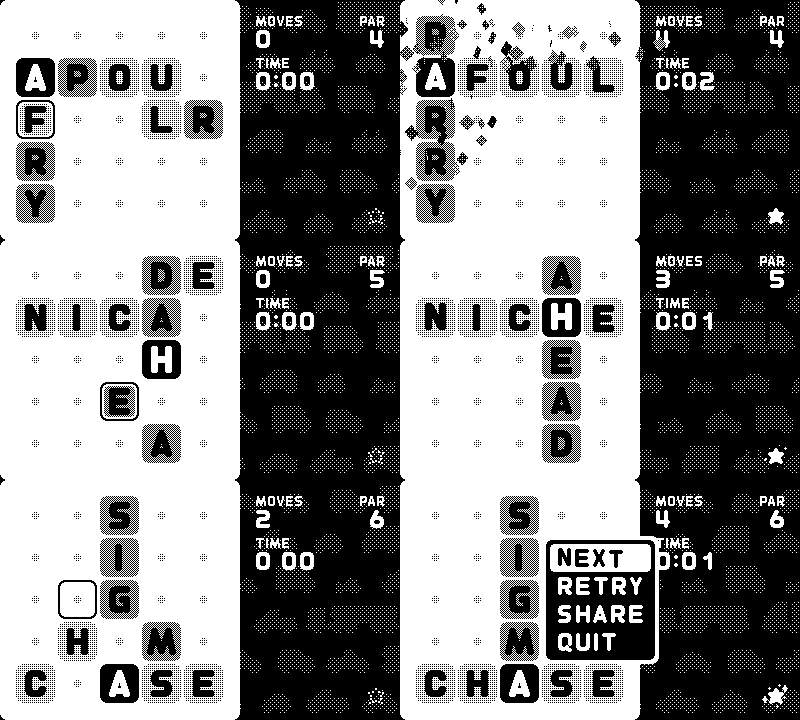
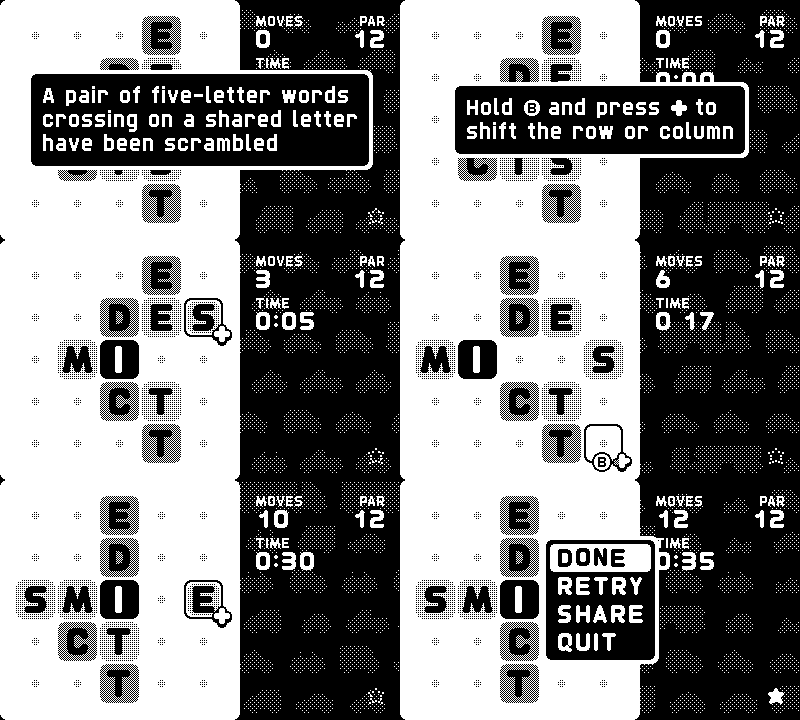
How the game works is that you have a group of nine letters laid out as Scrabble-like tiles on a 5 x 5 grid. These letter tiles will form two 5-letter words, with one letter being shared by both words and thus is the point where the words intersect. Your task is to rearrange the letters on the grid to spell out these two words, and you do this by sliding entire rows (horizontally) and columns (vertically) across the game board. Your goal is to reach the solution in as few steps as possible, so basically the game has golf scoring. Each board has a set “par” number and the player is aiming to solve the puzzle in that many moves or less.
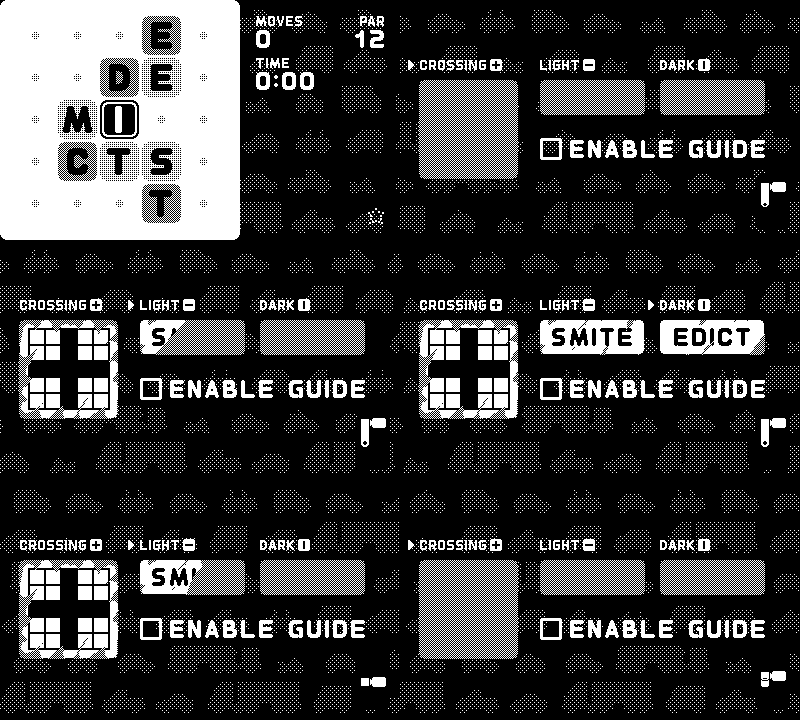
When I first jumped into Cross Words and tried to simply intuit the mechanics of the game, figuring out what words to form felt like an extremely daunting task. But then I realized the letter tiles are color-coded to guide you. (Or should I say “grayscale-code”?) Four of the tiles are always rendered in light gray, four are rendered in dark gray, and one tile is rendered in black. The black tile is for the letter that’s shared by both words, it’s the all-important intersection point. The light gray tiles seem to be for the horizontal word’s letters, while the dark gray tiles are for the vertical word. Once I understood the visual setup, the game was instantly more enjoyable.
In a strangely original aesthetic choice, Cross Words sports a commuting/city traffic theme. Game modes have names like Commute, Roadtrip, and Revisit. The background always displays orderly lines of cute vehicles slowing driving to the left or right. As background elements these cars, trucks, semis, etc. are not overly detailed, just mosaic silhouettes sliding across view. And the sound design especially drives home the auto aesthetic with plenty of engine rumbles and tire screeching sound effects, along with a game announcer that is literally the voice from GPS navigation.
Speaking of sound, this appears to be another Playdate title that uses a single tune for its music. Luckily the one track used in this game is pretty good, and rather ideal for background music in a puzzle game. It’s chill, unobtrusive, and can be repeated several times without getting on one’s nerves. You can also turn the music off from the pause menu quite easily, in case you get sick of it. So while being quite limited, I’d say the music here is still well done.

Well, Season 3 has surprised me yet again, because I actually enjoyed Cross Words quite a bit. Word games have never been a favorite of mine, golf scoring doesn’t pique my interest either, and literally no human person likes traffic. That said, I do have an affinity for grid-based puzzle games. The setup here is straightforward, the mechanics are simple, and the aesthetic is counterintuitively charming. Yeah, I have to admit it, this little word puzzler is a winner.
Week 4
Next up we have Chance's Lucky Escape 2 by Goloso Games & Julia Minamata, a lighthearted, comedic, point-and-click adventure game. This one is a direct sequel to Chance's Lucky Escape from Playdate Season 2, so you might be familiar with its wacky world of anthropomorphic characters. Chance the Dog is a bumbling criminal who—despite his utter incompetence—continues to elude arrest by the authorities through sheer dumb luck. This new game continues the adventure from the exact point the first game’s story ended, so I’d definitely recommend playing through the original before jumping into this one.
Chance's Lucky Escape 2 uses the full gamut of Playdate control inputs: the D-pad, A and B Buttons, and the Crank of course, but also the handheld’s Accelerometer and even the Microphone. And with such a wide range of inputs, you might expect that CLE2 gets extra creative with its scenarios, and I suppose it does. However, the way this game executes its wacky ideas felt unusually frustrating this time.
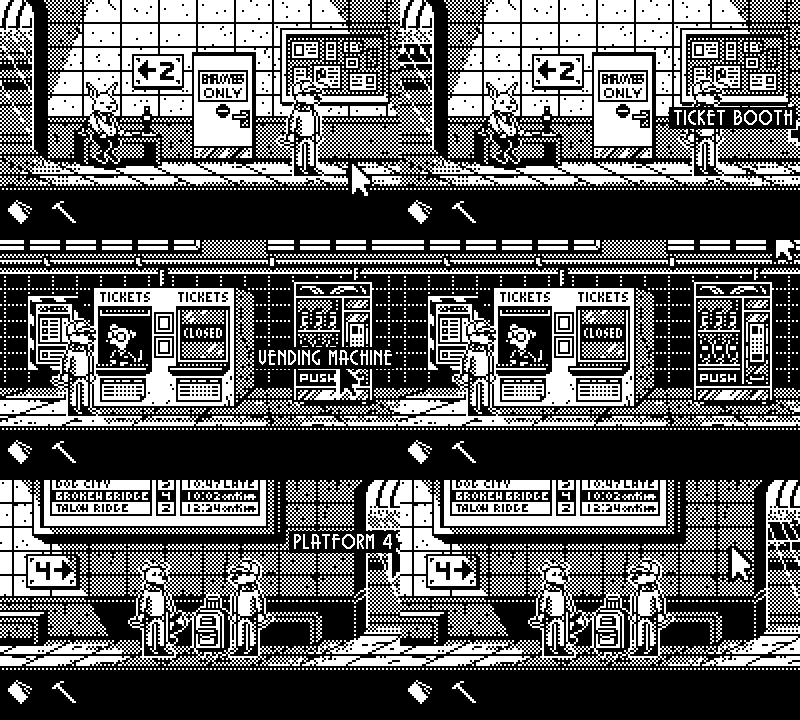
For example, right off the bat in Chapter 1, I got stuck with no idea of what to do to progress. Moving back and forth between three screens, I tried interacting with everything, but to no avail. There were only two items in my inventory, so I also tried the hammer—and the wallet too—on literally everything. That, of course, still went nowhere. As it turns out, I had to press the B Button on the wallet in the inventory menu to produce a new item, coins. See, you press A to ‘use objects’ and press B to ‘look at objects’. Okay…
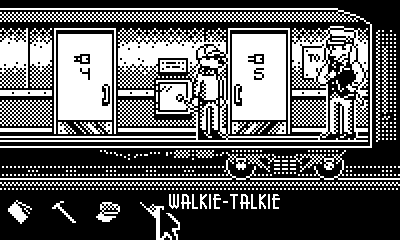
The unintuitive design didn’t end there though. Just a bit later on in that chapter, I need to select a conductor’s hat and use it on the ticket seller. Not on Chance himself, who would be wearing the hat, but on the ticket seller he’d be talking to. Then I needed to select the walkie-talkie and use it on the emergency instructions poster. Based on these examples, I’m guessing the player is never expected to click on Chance himself. And maybe if you know that going in, it will be less frustrating…maybe.
There is a fun gag where Chance shakes up a bottle of cola to make it explode in someone’s face. Since the game uses the device’s Accelerometer, you do this by physically shaking your Playdate. However, you still have to shake at the right time, which might be tricky to determine. Once again, the key is to use the B Button on the Cola in your inventory screen to ‘look at’ the object. When the text appears warning not to shake the drink, that is the time to physically shake the Playdate. Again, if you understand this mechanic going in, you will probably have more fun with the game than I did.
Chapter 2 has Chance riding a passenger train, and these train backgrounds were especially good-looking. Perhaps I am becoming my father, because I certainly enjoy trains and find them incredibly charming. However, it was right here in Chapter 2 that my patience ran out and I just gave up on this game completely.
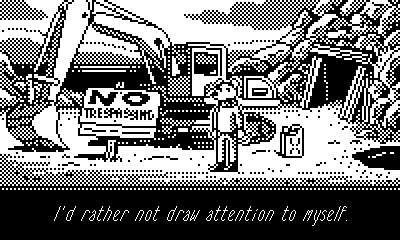
It’s strange, because I had a genuinely good time with CLE1 and the sequel would appear to be more of the same. And yet, for some reason, I don’t really enjoy CLE2 at all. I think my problem this time around is that every step you need to take to move forward feels incredibly random and unintuitive. With CLE1, I was able to figure everything out on my own and progress through the story with little to no frustration. But with this game, almost every move has felt incredibly random and inscrutable.
The game’s humor also hasn’t been landing quite as well for me this time. The original game surprised me with consistently funny gags from start to finish. But this game hasn’t managed to produce nary a giggle, titter, or smirk. I’m sorry to say, Chance's Lucky Escape 2 simply is not doing it for me. Perhaps we needed to teach this old dog some new tricks? Or maybe Chance’s luck has finally run out.

And last, but certainly not least, we have HELLEVATOR by DRD (aka Dylan Dougherty). When Panic first teased the games we’d receive in Season 3, this was the one that got me the most unreasonably excited. A 2D action platformer that involved descending into caves just immediately grabbed my attention, and the protagonist running around with a big drill was a nice touch. For some reason, I really enjoy digging games. Then I heard the levels would be procedurally generated, and I got even more pumped. See, I am an absolute Spelunky junkie, and this was beginning to sound very Spelunky-like.
When I first started playing though, I have to admit that I did not enjoy Hellevator nearly as much as I was expecting to. There were certain aspects of the game that turned me off, various design decisions that simply rubbed me the wrong way. In fact, the sense of disappointment was so palpable that when I initially drew up my Season 3 rank list, Hellevator wasn’t going to make it into the top half. While I did eventually come around to loving this game, I did almost dismiss it too soon.

Hellevator is a run-based game, and that, along with the use of randomized levels that descend into underground caverns, feels very much like Spelunky. However, unlike Spelunky, there is a progression system in Hellevator. Here you can unlock new equipment, and then upgrade your equipment with gems you’ve collected along the way. This was pretty jarring for me, as having to collect materials and upgrade gear is not a video game convention that I tend to find interesting…or even remotely fun. Depending on how much grinding is required, this sort of thing can turn me off of a game entirely.
One of the first things that bothered me with Hellevator is that the player begins the game extremely weak and underpowered. The presence of an upgrade system means that the player will grow in their capabilities as the game progresses, but you have to start somewhere. After making just a couple upgrades to the hero’s pathetic peashooter gun, it felt astoundingly more useful. And once I unlocked the jetpack, I realized that even your movement options will improve as you level things up. But wow, starting out with the bare minimum and no upgrades feels incredibly rough.
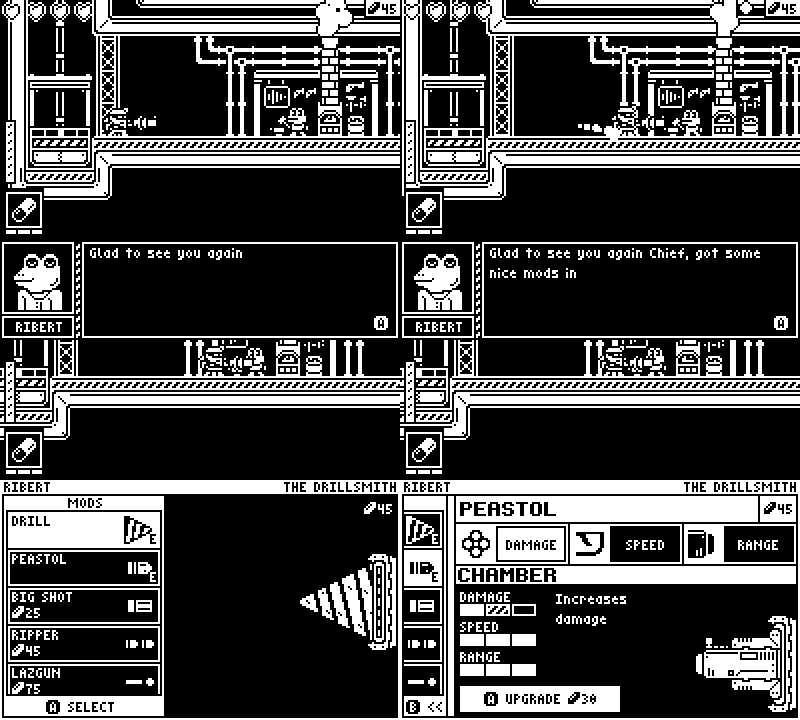
The game’s controls are serviceable, if a bit imperfect. Obviously the input options on the Playdate are rather limited, so developers are forced to get creative when allowing the player to take several possible actions. The A Button makes you jump, and the B Button either uses your drill or fires your gun. Now sure, technically the drill and gun are connected, but if the developer had more buttons to work with, he wouldn’t have had to map both actions to B. The climbing controls took some getting used to, feeling a bit awkward at first, but this implementation was probably the only option. When you press up against a wall, you simply press Up or Down on the D-pad to climb it. Pressing the A Button while climbing will throw you diagonally off the wall, kind of like a wall jump, so it’s only good for dismounting. The system felt awkward at first, but I eventually got used to it.
Players get access to a double-jump right off the bat. So if you’re into double-jumps, there’s that. Eventually you unlock a jetpack, and that basically becomes an extended double-jump with its own fuel gauge.
To get nit-picky for a moment, a few weird choices were made for certain things that I found pretty annoying. For example, you press Down on the D-pad to talk to characters and interact with things. To me, the correct input for this would be Up on the D-pad, and I’m not sure why the developer went with the opposite.
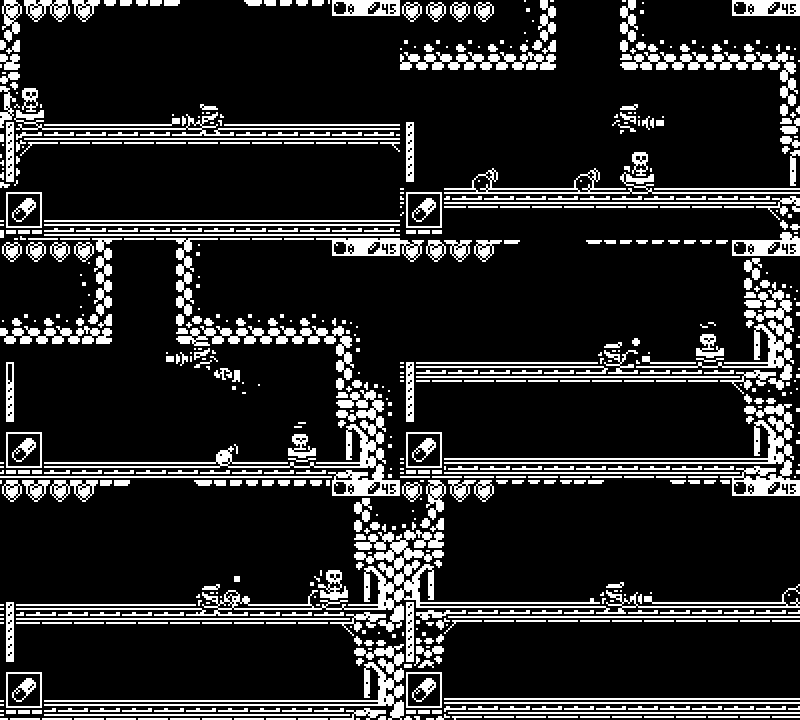
Similarly, when you get the ‘Shine bottle and gain the ability to recover hearts by drinking some health potion, the input to use it is Up, Up on the D-pad. While that’s not entirely counterintuitive—it does make me envision the player sprite leaning his head back to take a big drink out of a bottle—that input is something you are very likely to do by accident, just jumping around the game world. I think I’ve probably burned through half of my ‘Shine hearts by simply double-tapping Up when I didn’t mean to.
The lantern in this game basically serves as each level’s time-limit, because once it runs out, you won’t be able to see anything and could easily become stuck. While this seems like a decent mechanic in theory, I don’t like it nearly as much as Spelunky’s time-limit: an ominous ghost that slowly pursues the player and instantly kills them on contact. Spelunky’s ghost can potentially be avoided for some time before finally making it to the exit, and that can be thrilling. But the most important function it serves is that of Grim Reaper; it kills you and ends your run. Hellevator’s lantern running out doesn’t end your run, it just makes it frustratingly difficult to continue. So while you’ll probably wish you were dead, you’ll still have to take that extra step of manually ending your run through the pause menu.
On a positive note, the lock-picking mini-game that sometimes appears when you try to open a chest is really cool. It’s a clever use of the Crank and feel completely appropriate in-game. That was a great addition.
Visually Hellevator is decent, if perhaps somewhat inconsistent. The pixel art looks fine in most places, maybe not amazing but it certainly gets the job done. I’m not the biggest fan of the player sprite, or the initial zombie-like enemies you first encounter. The environments look pretty good overall…although there is one sprite that I think looks just like a treasure chest and apparently it’s just a random artifact containing nothing. (Oh…is it supposed to be a mine cart? I bet it’s an empty mine cart.) Little touches like the smoke/plume effects look extremely cool.
The music in this game is actually really good. I genuinely dig these tunes, and I found myself humming one of the melodies a while after playing. If you appreciate sweet 8-bit beats with your gameplay, this game will not disappoint.
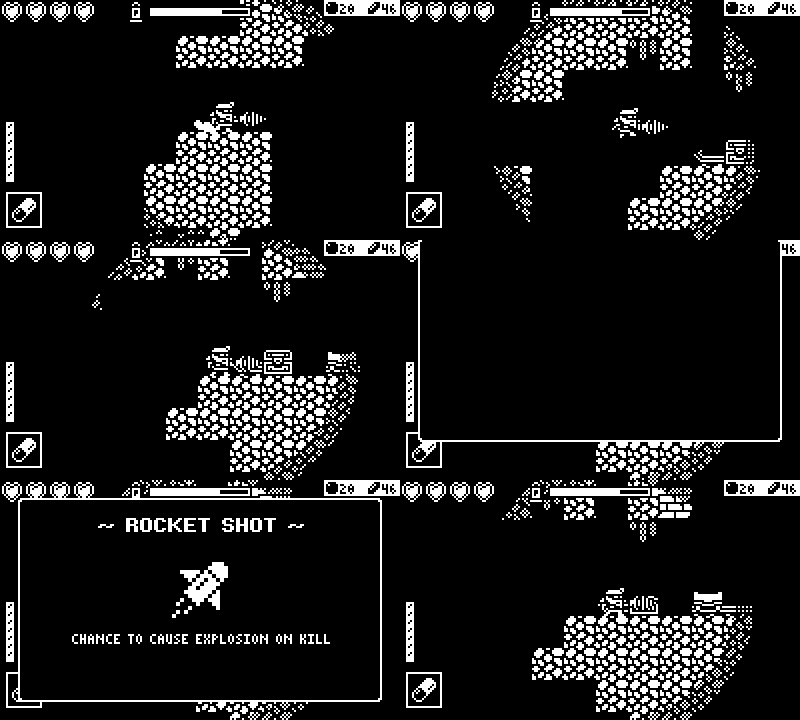
In addition to the permanent gear you can unlock and upgrade, this game also features “relics”—items that power up the player for that specific run and are lost when you die. There are apparently 24 different relics in the game and they do things like give you a triple jump, give you a second chance to pick a lock if you mess it up the first time, cause your dispatched enemies to explode when they die, or automatically use your ‘Shine to restore health when needed. These augmentations feel a bit more like items in Spelunky, since you can find them randomly and they only last for that one run. But with each relic you actually get a choice to take/use the item or simply “scrap” it to collect some amount of gold instead.
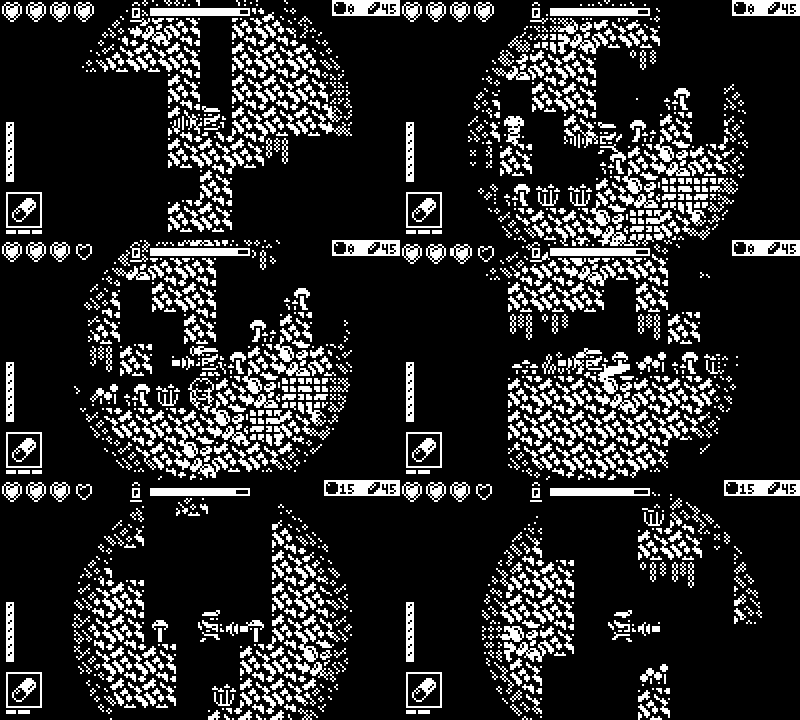
While the gear and upgrades system initially turned off a bit, I did find that they were actually pretty fun to engage with. The fact that you get a permanent jetpack and then you can upgrade it to be more capable actually kind of rules. And the game loop of doing a run, collecting some amount of gems, dying at some point, returning to your base, and upgrading your equipment for a better chance the next time turns out to be genuinely fun.
Hellevator is not Spelunky on the Playdate. As much as I may have wanted it to be, it simply isn’t Spelunky. It is its own game, with its gameplay loop, its own progression systems, its own original story and characters. After a 40-minute run in which everything started to click for me, I realized that I really can’t fault a game for doing its own thing. Hellevator is forging a new path on Playdate, and honestly, it’s pretty fantastic. Ultimately this title ended up being my favorite game of the season.
Wrapping up…
And that’s all folks! All eight games from Season 3 played, and all eight games reviewed. It was a shorter journey this time around, but surprises continued to abound. And with the bold creativity on display this time, the bar for quality remains as high as ever. Personally, I cannot wait for an inevitable Playdate Season 4. Let’s do it, Panic!
Finally, just as we did last season, I’ve put together a ranking list for you. Consider it a TL;DR, a cheat sheet version for busy people who can’t be bothered to read each review individually. Obviously ranking these games is purely subjective, but I feel my list remains completely accurate. To be specific, I’m ranking each game on how much I enjoyed playing through it, and factoring in how likely I am to play more of that game in the future.
Playdate Season 3 Rank List
HELLEVATOR
Gloom Gate
houm
Cross Words
Sound Mind
Soggy Froggy
Bonkhope
Chance's Lucky Escape 2
Happy Gaming friends! See you next time.